Soon after breakfast the next morning, dozens upon dozens of horses
arrived, by trailer or truck, in the company of their riders, both young and
old. It was clear that if we did not make a move, we would soon be hemmed in by
the equestrian types who were clearly not amused to have even fellow Kiwi tourists
clutter their space.
It had also been made clear over breakfast that The Chauffeur was keen
to check out the NZMCA’s newest park over property so we headed north up the
east coast, retracing routes travelled over the past few days, on up through
the lovely rural land which fringes the Bay of Islands, through surprisingly
vibrant Kaeo and on north skirting the Whangaroa Harbour, the road essentially
passing over the estuary. Soon we arrived at Mangonui, Coopers Beach where we
picked up some morning tea calories, then Cable Bay where we parked up to consume
them with thermos coffee.
Tokerau Beach lies on the northern shore of Doubtless Bay, en route to
lovely Maitai Bay, the DOC camp we stayed at last year (or was it the
previous?). We had never actually checked out the residential areas of the
settlement at Tokerau Beach, so it was a plus that our Tomtom took us via the
scenic route to our next camp.
 |
| Rangiputa on the Rangaunu Harbour |
Arriving at the cleared section, now fenced and grassed and apparently
ready for we gypsy members, we were horrified to see the state of the entry and
wondered whether we would become bogged down once through the gate. Fortunately
no such thing happened and this was probably more to do with the fact that I
stayed well away from the driving operation; hysterical wives have little
positive to contribute. And as we parked up next to the motorhome along the
fence, who should we find ourselves next to but the van we had been too cosy
with on that boggy camp at Rainbow Falls out of Kerikeri. How they must have
cursed our arrival!
 |
| Totara North on the Whangaroa Harbour |
That night the van was rocked and rolled by the buffeting winds coming
in from the south east, and it was those same winds, worsened by rain that
turned us away from Maitai Bay at the end of the peninsula the next morning. I
had been keen to do a walk out to the point, however neither of us was inspired
as we peered through the windscreen on arrival, nor encouraged to park up in
the camping ground for our next night. It would seem that our DOC Pass would
not be used at all and the cost would
have to be written off (by us) as pure donation.
 Instead we backtracked down the Karikari Peninsula and turned into
Rangiputa which sits on the southern edge of the large but shallow Rangaunu Harbour,
near its entrance. Despite being New Zealand’s fifth largest harbour, covering
115 square kilometres, Rangaunu is not a familiar name to the average kiwi. In
fact I am not even sure how to pronounce it. Sheltered from the winds we
lingered beyond the surprisingly built up settlement, reading and just soaking
up the atmosphere. Had we continued on a little way, we would have found a more
expansive reserve to park up. When we did walk on through to the small point,
we found other motorhomes had had the same idea as us; to hole up for the
morning out of the inclement conditions.
Instead we backtracked down the Karikari Peninsula and turned into
Rangiputa which sits on the southern edge of the large but shallow Rangaunu Harbour,
near its entrance. Despite being New Zealand’s fifth largest harbour, covering
115 square kilometres, Rangaunu is not a familiar name to the average kiwi. In
fact I am not even sure how to pronounce it. Sheltered from the winds we
lingered beyond the surprisingly built up settlement, reading and just soaking
up the atmosphere. Had we continued on a little way, we would have found a more
expansive reserve to park up. When we did walk on through to the small point,
we found other motorhomes had had the same idea as us; to hole up for the
morning out of the inclement conditions.
We travelled south again to Taipa and stayed at a private park over
property near the one lane bridge which is in the process of being replaced.
Our hosts, an elderly couple who offer their guests an A4 sheet of all that is
on offer as well as clearly spelling out their charges for various services
(electricity, water, laundry), left us to set up and wander down to the rather
dingy Foodmarket where we bought carrots at an inflated price. On the way back
up the road we spotted the fish’n chip shop and decided to shout ourselves
greasies for dinner, thus making the expensive carrots temporarily superfluous.
 |
| Morning tea at Pia Pia Reserve |
The next morning saw us again retracing our route, south through Cable Bay,
Coopers Beach, detouring around through charming Mangonui, although not so
charming in the wind swept drizzle.
Further south at the north end of the Whangaroa Harbour we turned east
and drove out to Totara North, nowadays a very small settlement, a community
hall, a bar and café, a derelict sawmill, a boat ramp and wharf, these latter
two offering the most activity. There were two significant fishing vessels tied
up here along with a large ocean-worn yacht which will be paying $30 a day for
the privilege of sharing the wharf with the industrious.
Totara North is a small settlement on the northern side of
Whangaroa Harbour. It is home to around two hundred close-knit residents and
has a primary school with 38 pupils, a community hall and gardens, The Gum Store bar and cafe, a now
derelict timber mill, a wharf, a shed for crayfish processing and a boat ramp.
 |
| Mature puriri at Waimate North |
The
steep bush-clad hills of this northern side of the harbour tumble almost all
the way into the sea and offer little flat land on which a town could grow, but
prior to the 1990's when the last privately-owned kauri trees were milled,
Totara North's proximity to the sea, the kauri trees and kauri gum fields,
allowed it to exploit its nearby kauri forests and to become a thriving and
prosperous community and a hub of commercial activity and enterprise in Northland.
In the 1870s a couple of boat builders set up shop here and turned out
wooden boats and ships up to 350 tons for all over the southern hemisphere,
using the local kauri and hardwood timbers. By the end of that century Lane
& Brown employed about a hundred men and had built over seventy vessels.
The enterprise obviously brought other business to the settlement; a school,
boarding houses, stores, a bakery, a rope works, a brickworks and a post
office.
These days the old mill belongs to Te Runanga o Whaingaroa, and until
recently this Maori administrative body
used what remains of the shed to house carved waka, hardly a safe and secure spot for treasured craft.
We wandered about for a while before setting out once more, but
soon turned off Highway 10 onto a secondary road that further hugs the very
beautiful but rugged coastline. This winding road is all sealed, and is
certainly steeper than the more inland route, but offers splendid views, We
stopped at Wainui, parking above the sea at the Pia Pia Reserve. From here the
bay lay out before us, the waves washing into toward the rocky pohutakawa clad
shore. What a glorious sight this must be in December when they are in full
bloom!
 |
| Quirky street furniture in Kawakawa |
Further south we gave Matauri Bay a miss although we did pause for a
photo opportunity on the road high above the bay. This is one of the jewels of
the coastline, however we would rather remember it as it was the first time we
drove in and stayed. Then the road was rougher, but did not take one past the
hovels the locals live in and there were no signs restricting the tourist to
parking areas from which no views can be enjoyed. Then too there was no
residential development, if roadways and infrastructure without construction
can be called “residential development”. All of this stalled several years ago,
when there was strife between hapu
members. Goodness knows the situation now, but from high on the hill it looked as
if folk like us had all decided to leave the locals to it. There is still a
sign indicating a motor camp down there, so I guess others might well discover
a very different story if they bothered to venture down the steep access. And
my comments here will be doing the locality no favours.
 |
| A rugged coastline |
The weather was still dodgy, but we still had days free before another
round of appointments and some new work required of which we learned as we came
into cellphone contact again. After refuelling at Whakapapa near Kerikeri, we
headed inland to the Bay of Islands P&I Showgrounds at Waimate North again;
a tried and true refuge, with power, toilets, musical magpies, swooping hawks
and swifts, and a herd of curious calves.
The next morning after a particularly peaceful night, we headed back to
Kaikohe, on now all too familiar roads, this mid-North having become our temporary
stamping ground. In the “metropolis” we stocked up at Countdown which offered
fair prices and an inferior ambiance to the New World just up the street. But well
satisfied with our shopping , we headed next to the dump where we spent a
rather lengthy time chatting with a honey-mooning couple from Exeter, keen to
learn the ins and outs of emptying a full toilet cassette. In the end, I
suggested we leave them to the rest of their sanitation requirements because they
had only five weeks (less the days it had taken to fill the aforesaid cassette)
ahead of them to see the rest of New Zealand.
 |
| Lunchtime views at Bland Bay |
We headed east again, this time to Kawakawa, home of the famous
Hunterwasser toilets, which we took the opportunity to use. This visit I was
more concerned about slipping on the wet tiles than enjoying the quirky and
colourful architecture, however that said, one should never miss the
opportunity to relieve oneself here if passing through.
As we toured south onto Highway 11, which would normally take one back
up to Paihia, we were accosted by several road workers whose sole occupation was
to turn back such travellers. The road across the hill to Opua was temporarily closed by a
slip which meant those heading through to Paihia would have to back track to
Puketona and travel in from there. I can only hope that few touring foreigners have
been discouraged from checking out that lovely area by the road closure.
 |
| Bounty of the sea awaiting the fillet knife |
However we were intending otherwise, to head across to the coast east of the Bay of Islands without relying on the
Opua ferry. To do this one must travel on a very windy gravel road up across
the edge of the Russell Forest, through the rather isolated Maori communities of
Karetu and Waikere, each of these situated up marshy estuaries of the Bay. Once
one reaches the sealed Russell Road, turns easterly and then south down the
coast, the rewards are well worth this inferior connecting road, although there are few spots to pull
over and admire the views of the churning sea and the rugged and rocky
coastline. We were keen to stop for lunch well before our day’s destination,
but were not able to do so until we reached Bland Bay on the Whangaruru Peninsula,
just kilometres short of our night’s camp. This is however a delightful spot
and we dined with views out to the open sea beyond the small sheltered bay, and
observed the oyster catchers and other tourists over lunch, both great
entertainment.
 |
| From the path to Picnic Bay |
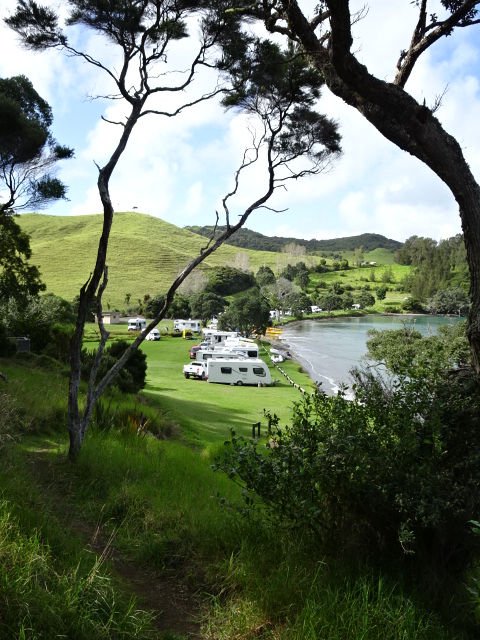
As we came down the steep hill into DOC’s Puriri Bay camp, we were
astounded at the number of camping parties there, given that we are at the end
of summer. The camp is now a well-manicured, sculptured and managed arrangement, where the guests come
after having reserved their ‘pods’ on-line and we were lucky to secure a spot
just one row back from the beach, without following normal procedure. Rules and
regulations and regimes rather spoil what was a fabulous wild camping spot, but
then it was 2005 whan we were last here.
This is a “scenic” camp which means there are on-site managers, toilets,
cold showers, rubbish and recycling facilities, and of course, beautiful
scenery. Most of those set up along the shore line were NZMCA members with DOC
passes, maximising their 14 day allowance, well set up with kayaks and fishing
gear, and sharp filleting knives to prepare their healthy evening dinner. We
were delighted to be presented with a bag of filleted fresh snapper from one
fisherman, surplus to their storage facilities and better on our table than flung back into the sea. But apart from watching the fishing
activities of these frugal folk, the kayaking antics of a group of school girls
and the coming and going of campers and wildlife, the rabbits and stray dogs, and
the views across the sheltered harbour, we did little during our two day stay.
 |
| Views down to DOC's Puriri Bay Camp |
One morning we walked across to Picnic Bay, then climbed up to a couple
of vantage points to take photos, and to pretend to be “active”, but most of
our time was spent reading and relaxing. This was after all supposed to be a little
holiday, although in truth the greater part of our life is one long holiday.
This morning we broke camp before 8 am and headed back to Whangarei,
accompanied for a while by the Whangaruru school bus, around the head of the
harbour, past the turnoff to Oakura, on past Mokau and Helena Bay, then up the
problematic Helena Bay Hill, a nightmare for those whose job it is to keep
roads open through the winter months. Soon we were back out on Highway One,
heading south. We called into Waro Lake at Hikurangi, which has become a
popular spot for whizz-bang camper types to overnight.
The lake and surrounding land is a refashioned limestone quarry, which over
the past few years has become a most attractive reserve offering walks and a
peaceful layby. Once before we used the
clean waters of the lake to wash off the road grime, and then ended up with
lime residue all over the van surface. I did remind The Chauffeur of this,
however he preferred to deal with the aftermath rather than drive the motorhome
into the city in its filthy state. And that is how we came to arrive looking so
clean and shiny after having travelled many kilometres on gravel road.
 |
| Waro Lake |
So here we are back in Whangarei to deal with those pesky issues that
have managed to catch up with us even on the road, to dine with friends who we
have so long neglected and sadly to attend a funeral , albeit of an aged and
ill relative by marriage. On a happier note we will attend our youngest
granddaughter’s afternoon tea tomorrow; it will be delightful to catch up with
Aurelia, her little friends and of course her family.

 The Pukenui Forest bounds on to the Western Hills Forest, making for a
1,500 hectare expanse of green bird sanctuary. The Pukenui State Forest itself
covers 592 hectares and was last logged in the 1920s. Since then there has been
healthy regeneration and happily, the logging rapists chose to leave many kauri
and other fine specimen of native trees. Evidence of DOC’s trap setters is all
along the walking trail which I find encouraging although my more suspicious
husband would say they put them near the trail to woo the public into thinking
they are doing a better job than the reality. Whatever the truth, the
population of stoats, weasels, rats and possums must in part be decimated by
even the smallest of efforts.
The Pukenui Forest bounds on to the Western Hills Forest, making for a
1,500 hectare expanse of green bird sanctuary. The Pukenui State Forest itself
covers 592 hectares and was last logged in the 1920s. Since then there has been
healthy regeneration and happily, the logging rapists chose to leave many kauri
and other fine specimen of native trees. Evidence of DOC’s trap setters is all
along the walking trail which I find encouraging although my more suspicious
husband would say they put them near the trail to woo the public into thinking
they are doing a better job than the reality. Whatever the truth, the
population of stoats, weasels, rats and possums must in part be decimated by
even the smallest of efforts.