I remember seven or so years ago my younger son asking what
I would do with myself now I was divesting myself of my business and occupation in order
to retire. I guess that after having had a frantically busy mother all his
life, sometimes, or even too often, to the detriment of family time, he could
not imagine me being anything else. Of course the intervening years have been
filled in the main with travel, and while overseas, every minute of every day,
doing so. I bring this all up because I have to confess that most of our days
since returning from the United Kingdom at the end of November have been all
too idle. I have consumed dozens of books from the library and book swapping
spots, done more cooking than the last six years combined and little else. How
sad is that!?
But there have been some little excursions and it is that
this blog is particularly reserved for, not my self-pity and reports of lazy
idleness. But even before we popped away from Whangarei, we did spend one
delightful afternoon doing what many grandparents do; attending a grandchild’s
cultural performance. Our youngest, who is not yet six, takes dance classes and
the dance school puts on an annual recital at year end, a collection of numbers
by the students, 99.9% of them female aged from three to fifty three at least.
While the choreography and costume were without fault, the execution of the
routines by the tiny tots was a scene of pure comedy. To see a clutch of tinies
in exquisite tutus and headwear, wander upon the stage of Whangarei’s
Bougainville Theatre, pause, look lost, then be rescued by black clad
“invisible” prompts, was absolutely hilarious. But I can report that our own
little Aurelia performed well, without too much hesitation and without
requiring rescue.
Days later we left Whangarei once more and headed to
Auckland, or Henderson more specifically, to deliver our unimaginative Christmas
presents to our youngest and his family. He and his partner were doing their
best to make the most of a childless weekend, their two sons having been taken
down to Nelson by their wonderful other-grandmother for a brief break in the sunshine and
seaside. The first childless and otherwise very private day was interrupted by
the other-grandfather who is also a wonderfully supportive figure in their
life, but could have been more absent this particular weekend. And then there was us, who did arrive with
notice duly given, to be dined and entertained. We did not stay too long but my
heart went out to this couple, who, with primary age children and one live-in
parent, have so little private space.
And on the subject of Christmas presents and the celebration
itself, I will repeat what I have surely conveyed before. Neither my husband nor
I enjoy “celebrating” this highly commercialised religious festival, nor the
anxiety caused by the build up of The Day which heralds the close down of all
commercial and practical life for three weeks down here at the bottom of the
Pacific. The idea of gifting for all at once is not only financially
challenging to most, but for me an exercise in total confusion. I wandered
about the stores some days before the aforementioned trip trying to imagine
what “normal” little girls liked, having never been a fluffy dizzy frilly girly
child myself, nor mother to the same; it was sons I spent my parenting days
raising, and boys are very different to girls no matter what these
“gender-equal” advocates may say.
We spent a night at the NZMCA Park at Tui Glen, that wonderful
little hideaway in very urban Henderson. There is a fabulous playground in the
public section of the park, which is well used by locals at the weekend. As we
wandered through the park threading our way past dozens of immigrant families,
we spied one in particular who had come with two large barbeque arrangements
and great big pots for the traditional “boil-ups”. Chris remarked that there
seemed to be no lack of food, a comment overheard and met with great mirth from
the large Polynesian men sitting around waiting for the feast.
The Westfield Mall in Henderson was full of Christmas
shoppers and the expected queue of parents waiting with their little treasures
to be photographed on Santa’s knee; one does wonder why parents will still
insist that their children be caressed by a strange man in a gaudy costume, despite
the horror stories that come out these days via media and the law courts.
Did I hear you utter – “Christmas Grinch?” Be honest, how
many folk really really embrace
Christmas?
Our other nights were spent down in South Auckland staying
at the Ardmore NZMCA Park which we found less crowded than normal. From here we
visited Armstrong Locksmiths up in Otahuhu where we were finally able to have
spare keys cut for our toilet hatch, a task better appreciated by those who
have experienced the loss than trying to imagine the situation.
From here we took the
opportunity to revisit the Onehunga foreshore at Mangere Bridge, a beautiful
and underrated spot in Auckland. Certainly Mangere Bridge has only been more
attractive since the sewerage works upwind were decommissioned; such stench
hardly makes for sought after real estate.
We walked along the winding pathway that extends from Ambury
Farm Park to the old Mangere Bridge and on up the northern shore of the
estuary, a cycle trail we have completed in the past. The bird life is
wonderful along this shore, particularly here along the Kiwi Esplanade.
 |
| Views along the Mangere foreshore |
The landscape here has been shaped largely by Mangere
Mountain, a volcano which erupted some 30,000 years ago. The mountain is one of
the largest and best preserved of Auckland’s fifty three cones and craters. All
of these volcanoes are the product of hot rock rising from one hundred
kilometres below the city. That source is still active and another volcano is
sure to erupt in Auckland area in the future, truly a scary thought.
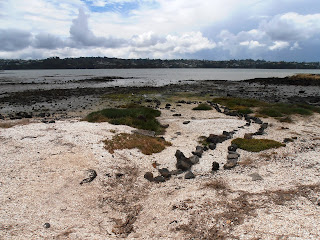
The lava spewed out during the eruption, is solidified and
exposed here on Kiwi Esplanade, making a strange surface known as “pahoehoe”, a
smooth, billowy or ropey surface formed as the lava chilled. It develops where
very fluid lava has continued to flow beneath a flexible crust, which twists
and wrinkles into ridged shapes.
The Manukau Harbour and Mangere foreshore provides habitat
for important international and national migratory wading birds, as well as
other local birdlife. The harbour supports more than 20% of New Zealand’s total
wading bird population. Each summer between September and march approximately
7,500 Bar-tailed Godwits and 7,000 Red (lesser) Knots travel
12,000 kilometres from northern hemisphere to
take advantage of the Manukau Harbour’s extensive
feeding grounds. These birds nest in the
tundra regions of Siberia and Alaska, but are driven south at the approach of
winter as their habitats begin to freeze. The waders arrive in their thousands
to spend summer feeding on the mudflats of the Manukau Harbour. The harbour
provides a rich source of food including marine molluscs, worms and other
invertebrates.
The South Island Pied Oystercatchers nest only in the South Island,
but after nesting, migrate to the harbour here and other North Island coastal
areas during the winter. Non-breeding birds remain in the North Island
throughout the year, while breeding adult birds return to the South Island
nesting sites. At high tide thousands of Oyster catchers gather on the grassy
reserve here beside the shore, a site that never fails to impress us.
As I said this is an underrated place; Mangere does not
generally inspire excitement amongst most of the Pakeha population of Auckland
and further afield.
When we did eventually
leave South Auckland to head north once more, we were met with traffic signs
that suggested frustratingly lengthy travel times, so we came north up the
Western Ring Road, joining the North-eastern Motorway via the still relatively
new Waterview Tunnel. I am not sure how much longer this route is, but the fact
that there is uninterrupted traffic flow and thus less stress, suggests this is
a better route north in such circumstances.
That day we lunched at the Rosedale Park, a wonderful sports
park near Albany where we have parked up to break our journey on many an
occasion. This is every bit as convenient as the sports park we had pulled into
at Warkworth on the way south. Both venues are locked up at night with notice
of expensive release fees, and I do wonder whether one could dare to overnight,
locked in, and stay free? This I do not know and am not personally willing to
try out, or at least just yet.
The next excitement was a day on Tiritiri Matangi, one of
the islands in the Hauraki Gulf but this one rather more special than most. The
Gulf covers an area of 4,000 square kilometres east of Auckland, and is part of the Hauraki Gulf Marine Park,
which itself covers an area of more than 1.2 million hectares. There are more
than fifty islands within the Gulf, many of which are public conservation lands
managed by the Department of Conservation.
The more well-known islands are Waiheke which is celebrated
for its vineyards and restaurants, and as a destination for Gold Card holders
who take advantage of free ferry rides much to the consternation of less
well-heeled consumers, Rangitoto with
its recently formed volcanic cone, and Ponui Island once a refuge for Salvation
Army rehabilitating drunks.
 |
| The 360 Discovery Cat at the Tiritiri wharf |
Tiritiri Matangi lies 3.4 kilometres east of the Whangaparoa
Peninsula and 30 kilometres north east of Auckland, covering just 220
hectares.
It is an open wildlife
sanctuary, a scientific reserve and one of New Zealand’s most important and
exciting conservation projects, managed by the Department of Conservation in
conjunction with the community group Supporters of Tiritiri Matangi.
The island is best noted for its birdlife, including takahe, North
Island kokako and the spotted kiwi. It attracts between 30,000 and 32,000
visitors a year, the maximum allowed by the Auckland Conservation Management
Strategy.
Originally the island was covered by a mixed pohutukawa
forest with kohekohe and taraire dominant in sheltered valleys, however
centuries of Maori occupation and subsequent European farming saw the majority
of the island converted to rolling grassland with only pockets of forest
remaining.
 |
| Looking back toward the wharf |
Maori occupation was fraught with conflict as with most in
this country; there is not, nor has ever been, harmonious tribal cohabitation.
Their war-like nature, particularly before the European brought them some
semblance of brotherly love cloaked in Christianity, still makes for squabbling
as attempts are made to settle treaty claims.
By the time Europeans eyed up the island, physical
occupation had long gone, although memories are long and never entirely
accurate or harmonious. In 1841 Ngati Paoa, rightly or wrongly, sold the land
to the Crown as part of the Mahurangi Block, and farming, as we understand the
term, began.
In 1864 a lighthouse was constructed at the southern end of
the island and remains in operation today albeit now automated. In 1956, a
xenon light was fitted to the lighthouse, creating the most powerful light-beam
achieved at the time by any New Zealand lighthouse. The last lighthouse keeper
arrived with his family in 1980 and after the light was automated a few years
later, he remained on managing the restoration programme and was DOC Ranger on
the island right through to 2006.
In the 1970s a chap from the Wildlife Service was given
permission to release kakariki, or red-crowned parakeets, onto the island and
that release caught the attention of a junior lecturer in zoolology at Auckland
University. It was this John Craig together with Neil Mitchell, and a few other
hangers-on who instigated the re planting of the island. This also required the
eradication of the predators who had made their way to the island over the
years and managed to further destroy the native vegetation and the birdlife;
the kiore rat being the first and foremost criminal.
Between 1984 and 1994 250,000 native trees and shrubs of
over thirty different species were planted. The rats were killed with aerial
drops of poisoned bait which had the side effect of decimating 90% of the pukeko population.
While I might say these comical birds are a hardy lot and surely able to regain
their numbers in next to no time, this should not negate the tragic lossat the
time.
 |
| The earnest Gerhard and his eager pupils |
Since that initial conservational and reinstatement of the
island, eleven native species have been relocated to the island as part of an on-going
restoration project. Today the bush is filled with the sound or evidence of
kakariki, the North Island saddleback aka tieke, the whitehead aka popokotea,
the stitchbird aka hihi, the North Island kokako, the spotted kiwi, the brown
duck aka pateke, the rifleman, North Island tomtit and the fernbird, the last
five which we failed to see on our visit. There are apparently eighty seven
species on or about the island and we saw but a portion of these, but were
still duly impressed.
We caught the bright yellow trimaran from Gulf Harbour which
ploughed its way through the rough seas for just half an hour to the island and
then took advantage of a guided walk for an additional $10 each around the
island to learn much about the birds, plant and insect life that is unique to
this sanctuary. Our guide is one of the
many volunteers from the mainland who offer their time, expertise and passion
for the island to visitors these volunteers making up the twenty or less who
are offered free travel by Fullers to facilitate this service.
 |
| Tiritiri Matangi's lighthouse |
Most of our fellow tourists were from overseas, and drank in
the imparted knowledge. But we did too, and learned much about the birds we
consider ourselves all too familiar with; the tui, kingfisher, bellbirds. We
sampled native celery, our local version of samphire and kawakawa peppers, all
adding to further understanding of our own environment.
 |
| Heading back toward the wharf |
The excellent weather we have enjoyed since our return to
New Zealand had changed since making our booking but then booking ahead is
always fraught with such danger. I had woken several times through the
preceding night and heard the showers pass over. Then just before the alarm
went off at 7 am, a wild storm passed over suggesting a disastrous day. As it
happened the winds did not abate which made for a less than pleasant sailing,
but the rain stayed away and the day was otherwise perfect. I did however think
of my sister who makes regular sorties out into the Gulf in all weathers; she
and her husband have a rather grand launch moored in the Marina and have a
greater appreciation of all-weather boating than I do.
We snuck away from the northern border of Auckland City after
an early rising, not willing to subject ourselves to the reported streams of
north bound holiday makers. As it happened the traffic seemed relatively
normal, and we were back in Whangarei soon after 10 am. After attending to half a dozen errands, such as gas refills,
gathering of our mail, and attending to a week’s worth of laundry, we set up camp
back out here on Jumbo expecting to remain for the next week or so. That roof
still needs painting and my husband’s procrastination must have a limit. In the
meantime I have received communication from my sister regarding Christmas drinks
at our parents’ tomorrow night. If it comes off, it will be the only “pre-Christmas
function” we will have had to deal with; a very different cup of tea from the
working years!


